
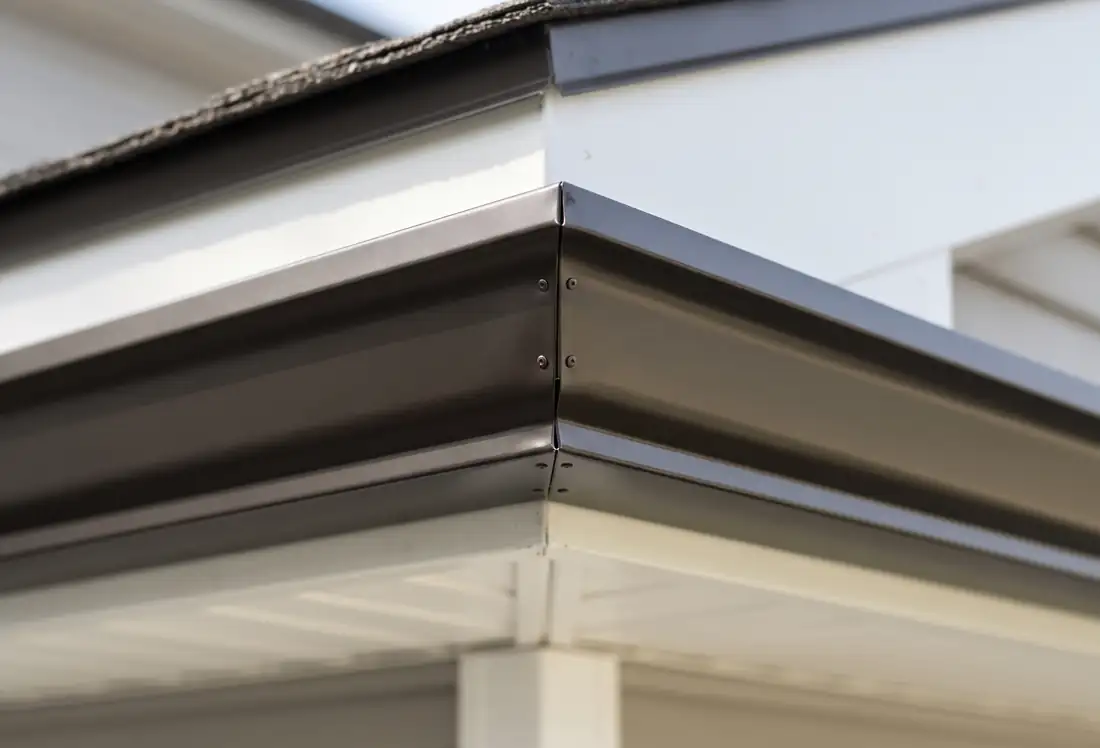
Where gutters leak
| Place | Why |
|---|---|
| Corners (mitres) | Two pieces joined with sealant; the most movement |
| End caps | Crimped and sealed; sealant dries out |
| Downspout outlets | A hole cut in the gutter with a fitting sealed in |
| Seams, on sectional gutter | A joint every ten feet |
| Old spike holes | Spikes have loosened and enlarged the holes |
| The back edge | Not a leak: water is getting behind the gutter |
Finding it
Wait for a dry day. Run a hose into the high end and walk the length. A drip from under a corner or cap shows the joint. Water appearing on the fascia behind the gutter means the trouble is at the roof edge.
A reseal that lasts
- Clean the gutter out.
- Scrape and wire-brush the old sealant away, back to metal.
- Dry the joint completely.
- Apply gutter sealant to the inside, worked into the joint and smoothed over it.
- Leave it to cure before it sees water.
- Test with the hose.
Most failed repairs skip steps two and three. New sealant over old, or over damp metal, peels within a season.
Why joints fail here
Indianapolis winters swing above and below freezing many times. The gutter grows and shrinks, and the sealant bridges the movement. After ten or fifteen years it hardens and cracks. Resealing every corner in one visit costs little more than resealing one.
When a leak means more
- Holes along the bottom. The metal has corroded through. Patching buys a year or two. Plan for replacement.
- A leak that returns. The joint is moving because the gutter is loose. See sagging gutters.
- Water behind the gutter. The roof needs a drip edge or gutter apron.
- Soft wood behind. The leak has been there a long time. See fascia and soffit repair.